- The 80 Plus certificate indicates a minimum level of energy efficiency of the power supply under specific loads, but does not by itself guarantee the overall quality of the PSU.
- There are six 80 Plus levels (Standard, Bronze, Silver, Gold, Platinum and Titanium) with increasing efficiency requirements at 20%, 50% and 100% load, and at 10% in the case of Titanium.
- The 80 Plus testing methodology has significant limitations (few measurements, low ambient temperature and little attention to standby), so it should be supplemented with the manufacturer's reputation and independent analysis.
- For most users, an 80 Plus Bronze or Gold power supply from a well-known brand offers a suitable balance between price, efficiency, noise, and equipment safety.
Whether you're building a new PC or want to extend the life of your existing one, the power supply is one of those components we tend to leave until the end… and we shouldn't. The famous 80 Plus certificate has become the benchmark for energy efficiency. in computer power supplies, but it's not always clear what it really means or how reliable it is.
In the following lines we will calmly examine what the 80 Plus certificate is, how it was created, what types of certification exist, how a source is tested to obtain it, and what problems the system entails. The idea is that you'll end up knowing how to interpret the 80 Plus labels and how to choose your PSU wisely.without letting yourself be swayed solely by marketing.
What exactly does the 80 Plus certification mean?
In a PC power supply, the main mission is transform alternating current (AC) from the electrical grid into direct current (DC) that can be used by the CPU, GPU, SSDs, fans, and the rest of the components. In that process, some energy is always lost as heat; no conversion is perfect.
The 80 Plus program was created to identify those sources that are capable of to utilize at least 80% of the energy they take from the plug under certain load conditions. In other words, an 80 Plus PSU guarantees, as a baseline, an efficiency of 80% or higher at several specific load points.
This means that if a power supply claims 1.000 W and has 80% efficiency, To actually deliver those 1.000 W to the PC, it will need about 1.250 W from the wall.The remaining 250 W are lost as heat within the power supply and the device itself. Greater efficiency means less energy waste and less heat to dissipate.
It is important to understand that All energy that is converted into heat is lost energyWhether we're talking about the power supply, the graphics card, or the processor, no component is perfect. The added value of an efficient PSU is that it draws less power and therefore needs fewer watts from the grid to deliver the same usable power.
Origin and evolution of the 80 Plus program
The 80 Plus program is not a recent invention. In 2004 the consulting firm Ecos (now Ecova Plug Load Solutions) defined the testing protocol for computer power supplies with multiple outputs, with the aim of promoting energy savings in desktop computers and servers.
Shortly afterwards, in March 2004, The initiative was publicly presented at the ACEEE Market Transformation SymposiumAnd in 2005, the first PSU meeting 80 Plus requirements, manufactured by SeaSonic, arrived on the market. This marked the beginning of "premium" efficiency in commercial power supplies.
In 2006, the US agency Energy Star decided integrate 80 Plus into its Energy Star 4.0 specification for computerswhich came into effect in July 2007. That step was key: from then on, major manufacturers like HP and Dell began to certify their power supplies according to 80 Plus, and by December 2007 there were already more than 200 models with the seal, quickly becoming a market standard.
Initially, only the basic 80 Plus level existed, but In 2008 the program was revised to add the Bronze, Silver and Gold categorieswith increasingly stringent efficiency requirements. Later, in October 2009, the Platinum level was introduced, and in August 2011, the demanding Titanium level, initially geared towards server power supplies with 230V input.
What is energy efficiency in a power supply?
When we talk about efficiency in a PSU we are referring to the relationship between the power it actually delivers to the components (DC output) and the power it takes from the grid (AC input), expressed as a percentage. It is a direct measure of how much energy is wasted as heat.
For example, if a power supply draws 100W from the wall and provides 80W of useful power to the PC, Its efficiency is 80%.The remaining 20W are dissipated as heat within the unit itself. Greater efficiency means less power consumption, less heat, and less noise, because the fan has to work less to cool the unit.
Efficiency, moreover, It is not fixed throughout the load curveA power supply unit (PSU) typically performs better at around 40-60% of its capacity than at 10% or 100%. Thus, the same power supply might have 90% efficiency at 50% load, but its efficiency could drop noticeably if it's barely working or at its maximum power output.
The mains voltage must also be taken into account. Power supplies typically exhibit better efficiency when operating at 230V than at 115VThis is due to the design of their input stages. Therefore, manufacturers typically publish data measured at 230V, and in countries like the United States (115V) the actual values may be somewhat lower than advertised.
Power factor and PFC: the other side of efficiency
In addition to "classic" efficiency, the following also come into play in a power supply: power factor (PF)which measures how efficiently the energy coming from the grid is used. The power factor is defined as the real power delivered divided by the apparent power (volts times amperes).
Without going into too many formulas, A typical uncorrected PSU usually has a power factor of 0,7-0,75This means it's "drawing" more current than necessary due to phase mismatches between voltage and current, which overloads the electrical system without providing any useful power. With power factor correction (PFC) circuits, active in most modern power supplies, this can be raised to around 0,9.
The 80 Plus certification doesn't just look at efficiency, it also assumes that the source incorporates PFC (normally active) to improve energy efficiencyDuring AC-DC conversion, capacitors and other components can cause phase shifts that lower the power factor, so the PFC circuit is responsible for correcting these losses.
It's worth remembering that a power supply is still a complex analog circuit, very sensitive to temperature and the quality of the internal componentsA mediocre design may pass the tests required for the label, but perform much worse outside of laboratory conditions.
How to certify an 80 Plus power supply
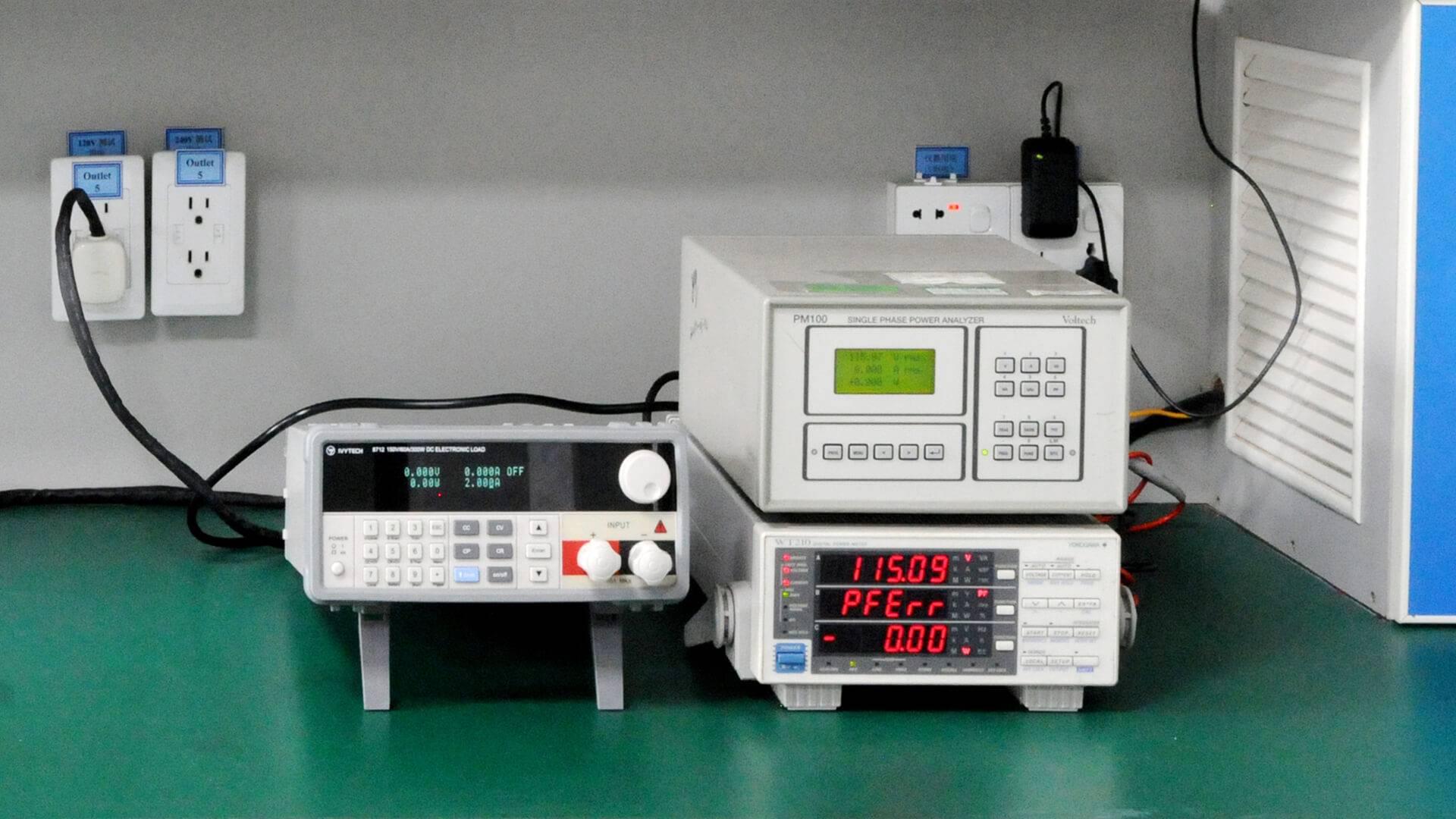
The 80 Plus program is voluntary and paid for manufacturersTo obtain the seal, the brand must register in the program, pay the corresponding fee, and send units of the font to an independent laboratory associated with the program, where the tests are carried out.
In these laboratories the PSU is subjected to certain load levels (usually 20%, 50% and 100% of its nominal power)The efficiency is calculated by measuring input and output power. In the case of Titanium, performance at 10% load is also evaluated because many of these power supplies are high-power and it's important to know how they perform at idle or under light loads.
The results obtained are compared with the official tables of the program. If the measured efficiency reaches or exceeds the minimum requirements for a specific level (Bronze, Gold, etc.), that label is awarded.These tests are quite rigorous in technical terms and are considered a good snapshot of performance under those specific conditions.
The laboratory charges for the service and, if the source passes the tests, The manufacturer may use the corresponding 80 Plus logo on packaging and marketing materials.In the case of rebranding (brands that sell an OEM font under their name), they may be able to use the original certification by paying a reduced fee, provided that the relevant font design is not modified.
Types of 80 Plus certification and efficiency requirements
Today we have six levels of 80 Plus certification for consumer power supplies: Standard, Bronze, Silver, Gold, Platinum and TitaniumEach level demands stricter minimum efficiency across various load points. Generally speaking, the higher the level, the more efficient (and usually more expensive) the power supply will be.
For desktop computers and workstations with non-redundant power supplies in Europe, at 230 V, Typical minimum efficiency requirements at 20%, 50% and 100% load are:
- 80 Plus (White or Standard): 82% at 20%, 85% at 50% and 82% at 100%.
- 80 Plus Bronze: 85% at 20%, 88% at 50% and 85% at 100%.
- 80 Plus Silver: 87% at 20%, 90% at 50% and 87% at 100%.
- 80 Plus Gold: 90% at 20%, 92% at 50% and 89% at 100%.
- 80 Plus Platinum: 92% at 20%, 94% at 50% and 90% at 100%.
- 80 PlusTitanium: 90% to 10%, 94% to 20%, 96% to 50% and 94% to 100%.
In the case of power supplies for servers and systems with redundant PSUs (typical in data centers), The tests are also performed at 230 V but with slightly different tablesdesigned for continuous use and the reliability requirements of those environments. For non-redundant desktop power supplies in North America, measurements are taken at 115 V and the minimum percentages change slightly.
Although the differences between one level and another may seem small on paper (2-3 efficiency points), At the internal design level, the complexity increases considerably.To scrape together a few watts of savings, you need higher quality components, more advanced topologies, and very fine control of losses at each stage of the power supply.
Therefore, PSUs with high certifications (Gold, Platinum, Titanium) usually have a significantly higher price.However, in return they consume less energy, generate less heat, and are quieter. For equipment that is switched on for many hours, this extra cost can be recovered in the form of savings on the electricity bill.
Relationship with European regulations (ErP Lot 6 and Lot 3)
Beyond 80 Plus, there are specific directives in the European Union that They limit standby power consumption and the behavior of certain power supply rails.Two of the most important are ErP Lot 6 (for energy-related products) and ErP Lot 3 (for computers and servers).
ErP Lot 6 states that Any electronic device should consume less than 1W in standby mode.This limit was reduced to 0,5 W in 2013. ErP Lot 3, for its part, requires that PC and server PSUs consume less than 5 W when the load is equal to or less than 2,75 W on the 5VSB line, with universal 100-240 V input.
Despite the importance of these requirements, The 80 Plus methodology does not directly measure or require these parametersThe program focuses on on-load efficiency on the main rails (+12V, 5V and 3,3V), and ignores both the 5VSB circuit efficiency and overall standby consumption.
This means that a font can display a relatively high 80 Plus label and yet, failing to comply in an exemplary manner with European directives on low standby power consumptionThis is especially relevant in homes and offices where equipment spends many hours in sleep mode or turned off but connected.
Limitations and problems of the 80 Plus certificate
Although the 80 Plus program has helped raise the minimum efficiency level in the market, It is far from perfect and has several significant shortcomings. which is something to keep in mind before putting all your faith in the sticker on the box.
One of the main criticisms is that, in order to grant the certificate, Only one or two units of each model are tested under very specific conditions.From there it is assumed that all PSUs produced under that name will behave the same, but in practice there may be differences from batch to batch or changes in components that no one audits again.
The second big problem is that The tests are performed at an ambient temperature of approximately 23 °C (±5 °C)This means that, legally, a power supply could have been certified as operating at only 18°C, something completely unrealistic inside a modern gaming PC, where it's not uncommon to see 35-40°C inside the case.
The higher the operating temperature of a PSU, Its efficiency is usually worse, and the stress on its internal components is greater.Evaluating it at such low temperatures does not truly test the lowest quality components nor reflect the real-world performance in a typical home tower.
Furthermore, Standard 80 Plus measurements are made at 115V for non-redundant desktop power suppliesand then extrapolate results for 230 V or vice versa, instead of thoroughly measuring both voltages under more scenarios. Although many power supplies are tested at 230 V for Europe, the underlying methodology is not optimized to cover all real-world use cases.
Limited measurements and behavior at low loads
Another point of contention is the number of measurements. At all levels except Titanium, data is only taken at 20%, 50% and 100% chargeTitanium adds 10% charging as an additional requirement, but it is still a very poor curve to describe the full behavior of the power supply.
In practice, a PC used normally spends a good part of its time under low or moderate load, far from those three fixed pointsIt is very common for an office computer or a home desktop computer to operate between 10-40% load for most of the day, precisely where the label provides the least information.
This opens the door for some designs to be optimized almost exclusively to perform very well at the “official” test pointssacrificing some efficiency outside of those areas. In fact, an unscrupulous OEM could send "tuned" units to the lab that perform better than the rest of the production in those specific percentages.
The consequence is that a power supply can easily meet the minimum of its 80 Plus level at 20-50-100%, but drop below 80% efficiency when the PC is at rest, in prolonged idle, or under light useExactly the kind of scenarios that matter for consumption in homes and offices.
In addition to this, if the manufacturer changes internal components, topology, or suppliers Halfway through the model's commercial life, it is no longer required to repeat the 80 Plus tests. The certification remains displayed on the box, even though the internal font is no longer exactly the same as the one used in the lab.
Standby power consumption and 5VSB voltage
Even with the PC turned off and even with the rear PSU switch in the “off” position, There may still be a small amount of consumption called phantom or parasitic usage.This is largely due to the 5VSB circuit (5V standby). This energy does "nothing useful," but is lost while the power supply is connected to the mains.
Modern ATX specifications indicate that The efficiency of the 5VSB rail should be measured and kept under controlHowever, the 80 Plus methodology completely ignores this line in its tests, focusing only on +12V, 5V and 3,3V (and, residually, -12V, a voltage that almost no modern component uses anymore).
This means that, even if a PSU has a high-level label, We don't have clear information about its standby power consumption or the efficiency of 5VSB.For the European user, where ErP directives are relevant, this is a significant omission.
In practice, if a font has not been designed with these regulations in mind, may exceed standby power consumption limits Marked by the EU despite boasting a more than respectable 80 Plus certification. Again, the label is useful, but it doesn't cover everything.
Fake certificates and lack of transparency
Another serious problem is that There is no particularly strict control over the misuse of the 80 Plus logoSome sources, especially from little-known manufacturers, display seals on the box that do not correspond to any real certification registered in the program's database.
The program provides a generic logo for each level (Gold, Bronze, etc.), but It does not include unique identifiers, QR codes, or elements that link each sticker to a specific model.This makes it easier for certain unscrupulous manufacturers to "grab" a badge they simply haven't earned.
Theoretically, anyone interested can consult the Official 80 Plus database to check if a source is truly certifiedThe problem is that very few consumers do so, and the program itself does not seem to have the capacity or resources to proactively pursue these cases.
Therefore, when you see a PSU with a strikingly high price tag and a suspiciously low price, It is advisable to be wary and stick to brands with a good reputation. (Corsair, Seasonic, EVGA, ASUS, Gigabyte, Cooler Master, FSP, Antec, etc.) or models tested by the community and independent reviews.
Is the 80 Plus certification really reliable?
Being sincere, 80 Plus is a useful reference, but not an absolute guarantee of quality or peace of mind.There are several compelling reasons not to use it as the sole criterion when choosing a source.
First, because Only a very few units are tested per modelAnd there's no guarantee that the entire production run will maintain exactly the same level. Changes in capacitor suppliers, adjustments to the circuitry, or simple manufacturing variations can alter the actual performance without the certificate changing.
Second, because The test environment (temperature, voltage, number of load points) is quite idealized and does not represent all real-world situations. that the power supply will use inside your tower. What happens between 20% and 50% load, or in deep sleep, is simply not taken into account.
Furthermore, The certificate has become a marketing cost. For many companies, it's a seal that users associate with quality, even though it only signifies minimal efficiency under a handful of conditions. A model without 80 Plus can be perfectly decent, and one with Gold might fall short due to poor quality control.
For all this, The most sensible approach is to combine the information from the 80 Plus certification with the manufacturer's reputation, the warranty offered, and independent reviews.It's not that 80 Plus is useless, on the contrary, but its methodology was born more than a decade ago and has not evolved at the pace of modern hardware.
How to choose the right 80 Plus certification for your PC
Now that you know all this, which 80 Plus label are you interested in looking for on your next water source? The choice depends on the type of equipment, the budget, and how many hours a day it will be switched on..
For an average user with a basic or mid-range PC (office work, browsing, some moderate gaming), An 80 Plus Bronze power supply is usually more than enoughIt offers good theoretical efficiency without a skyrocketing price, and there are many reliable models in that range.
If your computer has mid-to-high-end or high-end components, and you do video editing, rendering, or play games for many hours with a powerful GPU, It might be worth investing in an 80 Plus Gold or even Platinum PSUNot only because of efficiency, but also because these ranges usually come with better electrical protections and higher quality internal components.
The highest certifications, such as Platinum and especially Titanium, They make more sense in demanding workstations, home servers, or PCs that run almost 24/7.The accumulated savings in electricity and the lower heat generation can justify the extra cost if the total consumption of the system is high.
In any case, before you rush to buy, it's a good idea calculate the approximate power Determine the power requirements of your computer (using reliable online calculators) and look for a power supply whose rated wattage allows the PC to operate, under normal use, at between 40% and 70% load. This is where most modern PSUs perform best.
80 Plus and generic brands: what happens without certification?
They still exist in the market many generic or OEM sources that do not have any 80 Plus certification. They are common in cheap brand PCs, very low-priced clone computers, and in certain non-specialized stores.
Not having 80 Plus certification doesn't automatically mean the font is a disaster, but Normally, their efficiency and build quality are lower. to those of a modern, certified PSU. In the long run, this can translate into higher power consumption, more heat, and a greater risk to the other components if something fails.
In Spain and in the EU, 80 Plus certification is not a legally mandated requirementHowever, it is a de facto standard in the mid-to-high-end segment. At a minimum, it is recommended that the power supply meet an 80 Plus (White) or Bronze standard and that the brand has a proven track record in the industry.
In the end, Investing a little more in a good PSU is usually cheap compared to the total cost of the equipment. And, above all, what you would lose if a poor quality power supply damages the motherboard, GPU, or hard drives after a power surge or internal failure.
Looking at the whole picture, the 80 Plus certification is a valuable tool for guiding you when buying a power supply, provided you understand its limitations: it indicates a minimum level of efficiency under specific conditions, helps compare models on paper, and has pushed the industry towards cleaner and quieter designs, but It does not replace the judgment when choosing the appropriate brand, model, and range for each type of PC..
Table of Contents
- What exactly does the 80 Plus certification mean?
- Origin and evolution of the 80 Plus program
- What is energy efficiency in a power supply?
- Power factor and PFC: the other side of efficiency
- How to certify an 80 Plus power supply
- Types of 80 Plus certification and efficiency requirements
- Relationship with European regulations (ErP Lot 6 and Lot 3)
- Limitations and problems of the 80 Plus certificate
- Limited measurements and behavior at low loads
- Standby power consumption and 5VSB voltage
- Fake certificates and lack of transparency
- Is the 80 Plus certification really reliable?
- How to choose the right 80 Plus certification for your PC
- 80 Plus and generic brands: what happens without certification?