- LG's WOLED Tandem panels offer increased brightness, refresh rate, and lifespan compared to classic OLED, with 5K2K and 27" models focused on gaming and creation.
- High-resolution 5K, 6K, and 8K monitors, along with ultrawide and super ultrawide displays, are increasingly replacing dual-monitor setups.
- Asus consolidates its dual-screen laptops with the Zenbook Duo and the ROG Zephyrus Duo, geared towards creative productivity and extreme gaming.
- Mini LED, IPS Black and the first steps towards MicroLED complete a picture where the screen becomes the central focus of the workstation.
If you've been thinking about upgrading your computer setup, you've probably noticed that dual-up monitors, ultrawide displays, and dual-screen laptops are popping up everywhere. The feeling is clear: the display industry is tired of doing "more of the same" and is investing heavily in new formats and technologies designed for productivity, gaming, and content creation.
In this context, the coming years are going to be especially interesting: tandem WOLED monitors with dizzying refresh rates, 5K, 6K, and 8K panels, giant ultrawide displays, laptops with dual 3K OLED screens , and even the first steps toward MicroLED. All of this points to a scenario in which the classic "16:9 monitor + standard laptop" combo will coexist with much more flexible configurations, designed to make the most of every inch of screen space.

WOLED Tandem Monitors: Extreme brightness and insane frequencies
Among the technologies that will make the most noise, one of the main protagonists will be LG's new generation of WOLED Tandem panels , which seeks to go a step beyond traditional OLEDs in brightness, speed and lifespan.
LG is preparing a 39-inch ultrawide monitor with 5K2K resolution (5.120 x 2.160 pixels) and a curved WOLED Tandem panel, a perfect format for those who want to replace a dual-monitor horizontal setup with a single widescreen display without a frame in between. This “WUHD” resolution combines the vertical sharpness of 4K with extra width ideal for video editing, large spreadsheets, or advanced multitasking.
In addition to this 39-inch model, LG is working on two 27-inch monitors also based on WOLED Tandem technology . The first, known as the LG 27Q, will offer 1440p resolution with an extremely high refresh rate and a dual mode that allows the resolution to be reduced to 720p to further increase the refresh rate, geared towards eSports and competitive games where every millisecond counts.
The other model, the LG 27U, will opt for 4K resolution at a lower refresh rate, prioritizing image quality, detail, and color fidelity over extreme smoothness. This approach is better suited for content creators, photographers, videographers, or users who require precision above all else.
Everything points to us learning more about this family of monitors at CES 2026, where LG will showcase its strong commitment to WOLED Tandem in both 27″ formats and large ultrawide screens.
What does WOLED Tandem really offer compared to classic OLED?
The beauty of WOLED Tandem lies in how the panel is constructed: instead of a single organic emissive layer, two stacked emissive layers are used . This way, each layer operates at a lower voltage to achieve the same brightness, resulting in several key advantages over current OLEDs.
According to data from LG, this WOLED Tandem architecture opens the door to refresh rates of up to 540 Hz in standard mode and up to 720 Hz in dual mode , levels designed for very specific niches such as competitive shooters or experimental monitors for esports. Obviously, not all commercial models will reach these figures, but it represents the theoretical limit of the technology.
In terms of brightness, traditionally one of OLED's weakest points, WOLED Tandem boasts a peak of up to 1.500 nits in HDR modes, significantly exceeding many current OLED panels. This noticeably improves the impact of highlights in movies, HDR games, and high-contrast content, while simultaneously reducing the risk of burn-in thanks to more efficient power management.
LG also mentions color reproduction with up to 99,5% accuracy in professional coverage, deep True Black-type blacks even at relatively high brightness levels, and a more comfortable viewing experience thanks to anti-reflective treatment and Flicker Free operation , something essential for those who spend many hours in front of the screen.
In short, WOLED Tandem arrives to reinforce what traditional OLED already did well (infinite contrast and near-instantaneous response times) by adding more brightness, greater efficiency, and improved longevity . It's not a complete revolution, but it is a significant evolution that we will see expand to more sizes and formats between 2026 and 2027.
QD-OLED, WOLED and Tandem OLED: real differences in practice
Alongside WOLED Tandem, the market is already full of Samsung's QD-OLED and LG's WOLED panels , which, although sold as very different technologies, are more similar in everyday use than marketing departments want to admit.
In "classic" WOLEDs, LG uses a white OLED emitter combined with color filters (and often an extra white subpixel) to generate the image, while QD-OLED opts for a blue OLED layer whose light is converted into red and green by quantum dots, eliminating the traditional RGB filter.
On paper, QD-OLED can offer more saturated colors at high brightness levels , something especially noticeable in demanding HDR content. However, in terms of user experience—contrast, black levels, response times, viewing angles—both types perform fairly well for gaming and movies.
Both do, however, share common limitations: lower average brightness on full screen compared to LCDs with Mini LEDs , and a certain risk of image retention or burn-in if static images are overused (HUDs, taskbars, bookmarks, etc.). Manufacturers have made significant improvements in mitigation—pixel shifting, panel refresh rates, protection algorithms—but these are still organic technologies with a finite lifespan.
Both WOLED and QD-OLED use non-standard RGB subpixel structures (WRGB in LG and a triangular arrangement in Samsung), which can result in less-than-perfect text edges at small sizes on desktop for the more discerning user. Generally, it's not a major issue, but it's worth keeping in mind if reading or programming for extended periods is your priority.
Mini LED and IPS Black: LCD refuses to retire
While OLED grabs headlines, LCD technology is still very much alive, thanks in large part to two key advances: Mini LED with advanced local dimming and IPS Black as an evolution of the traditional IPS.
Mini LED monitors integrate hundreds or thousands of local dimming zones behind the LCD panel, attempting to approach OLED contrast by controlling the brightness of each zone. On paper, this sounds fantastic, but in practice, it encounters several problems: blooming (halos around bright objects), somewhat slow dimming response times, and high manufacturing costs.
In gaming monitors, many Mini LED models have had to choose between higher HDR brightness with more visible halos or more moderate brightness to reduce blooming, at the cost of reduced visual impact. In addition, some local dimming introduces extra latency of 20-30 ms, which is noticeable in fast-paced games or even when moving windows on the desktop.
On the other hand, LG has developed IPS Black, an evolution of the standard IPS that roughly doubles the native contrast ratio , going from ~1.000:1 to ~2.000:1. For the user, this means visibly deeper blacks and less "gray haze" in dark scenes, while maintaining the classic advantages of IPS: good color, wide viewing angles, and reasonable response.
A prime example is the new 32-inch 6K display (approximately 6.016 x 3.384 resolution) that uses Nano IPS Black technology, capable of covering around 98% of DCI-P3 and 99,5% of Adobe RGB. With approximately 218 ppi, it offers sharpness similar to a 5K iMac but with more workspace, ideal for photography, video, or design professionals.
High resolution: 5K, 6K and 8K for those who need every pixel
If you feel that 4K is no longer enough, the good news is that 5K, 6K and even 8K monitors are starting to become more prevalent around 2025-2026, especially for professional and demanding uses.
27″ 5K (5.120 x 2.880) displays like the Apple Studio Display or LG UltraFine 5K have already shown that a density of around 218 dpi is ideal for crisp text without needing to over-scale the system, something highly valued by programmers, developers, video editors, or creators who spend their days in front of the code and the interface.
The 32″ 6K panels maintain that 218 ppi density, but with a much larger working canvas : they allow for a giant video timeline, browser tabs, editing tools, and 100% preview without feeling cramped. The trade-off is usually the refresh rate, which in most of these models is around 60 Hz, sufficient for productivity tasks but less than ideal for demanding gaming.
At the top of the range are 8K monitors, typically 32″ with a resolution of 7.680 x 4.320 and a pixel density approaching 280 dpi—a truly outrageous amount for a desktop . These are niche products, designed for very specific workflows (print proofing, extreme CAD, scientific visualization), and even today they are still limited to 60 Hz and very high prices.
The arrival of DisplayPort 2.1 and Thunderbolt 5 will make it easier for some of these ultra-high-resolution panels to reach 120 Hz, at least with DSC compression, opening an interesting door to high-end hybrid monitors for work and leisure.
Ultrawide, dual-up and super panoramic: goodbye to bezels
Another very clear trend for the coming years is the growth of ultrawide (21:9) and super ultrawide (32:9) screens , which in practice replace double or triple monitor configurations with a single curved panel.
Gamers are already very familiar with the 34″ 3440 x 1440 or 38″ 3.840 x 1.600 format, but now much more radical options are becoming popular: 45″ WUHD (5.120 x 2.160) OLEDs at 240 Hz with pronounced curves, 49″ 32:9 monitors that are equivalent to two 27″ QHD monitors stuck together, and mammoth 57″ Mini LEDs with a resolution of 7.680 x 2.160 and 240 Hz.
In gaming, these screens offer incredible immersion: an expanded field of view in flight simulators, driving games, RPGs, or shooters ; perfect blacks in the case of OLED; and plenty of space for complex interfaces. However, they do require very powerful hardware to handle so many pixels at high refresh rates.
In terms of productivity, a well-utilized ultrawide monitor can easily replace two or three other monitors: traders, developers, content creators, or professionals who work with many windows open benefit from a seamless surface and improved uniformity . 5K2K models (5.120 x 2.160) also combine good vertical density with ample usable width.
It's worth noting that pixel density decreases at certain screen sizes. For example, 45" OLED displays with 3.440 x 1.440 resolution don't display text as sharply as a 27" 1440p display, which might seem a bit rough for intensive office use. That's why the industry is releasing new intermediate resolutions like 5.120 x 2.160, which offer a better balance between immersion and sharpness.
Alongside these formats, "dual-up" configurations are beginning to emerge, where a single, very tall screen or two vertically stacked panels replace the classic side-by-side setup. This approach is particularly convenient for reading code, editing long documents, or monitoring applications where height is a key factor.
Laptops with dual screens: Asus Zenbook Duo and ROG Zephyrus Duo
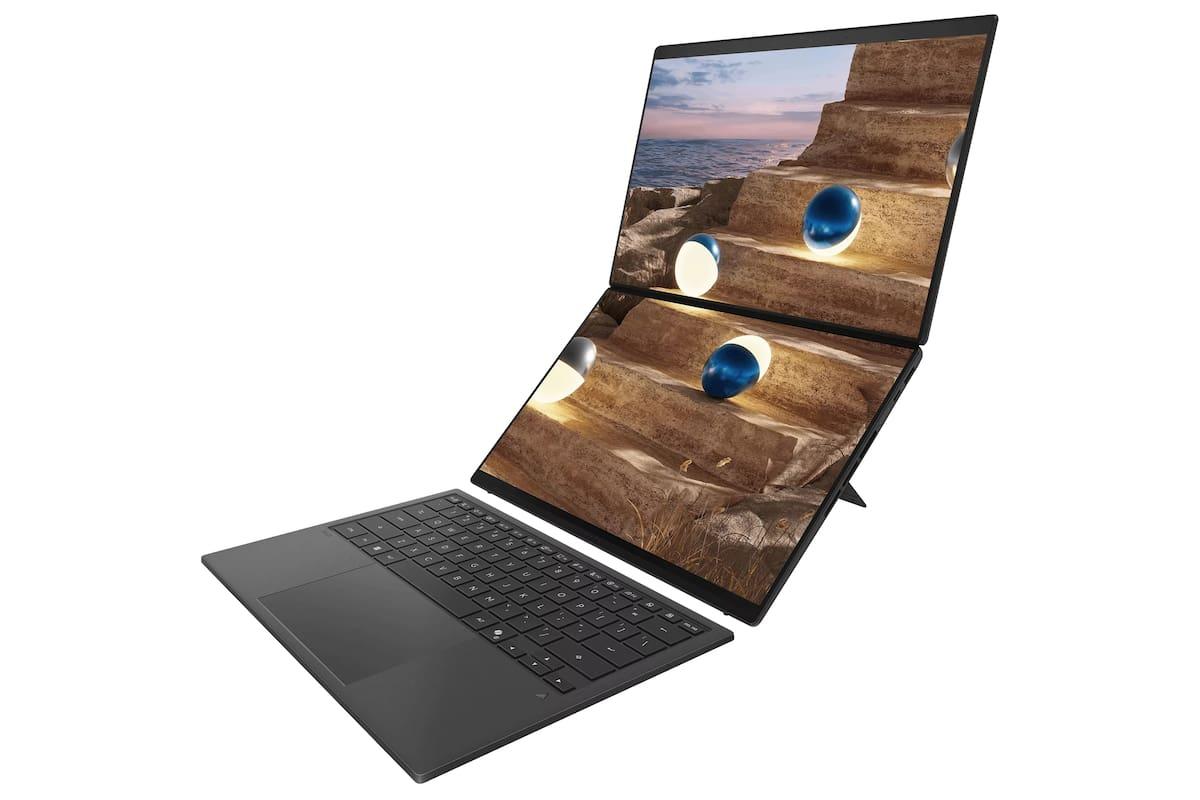
Beyond the desktop monitor, the dual-screen revolution is also reaching laptops, and here Asus is literally kicking down the door with its Zenbook Duo (2026) and the ROG Zephyrus Duo , two very different approaches under the same idea: the dual panel as a real work tool, not as a simple experiment.
The Zenbook Duo 2026 is positioned as a 14-inch dual-OLED 3K laptop designed for professionals and creatives who frequently switch between editing, browsing, video calls, and heavy multitasking. It maintains a very light weight of 1,65 kg and features a Ceraluminum chassis, an Asus proprietary alloy that blends aluminum with ceramic to offer enhanced resistance to scratches and impacts.
Under the hood, this model features next-generation Intel Core Ultra processors (Panther Lake/Core Ultra X9) paired with Intel Arc graphics and an NPU capable of delivering up to 50 TOPS, within a platform that reaches a total of around 180 TOPS in the most powerful configurations. This places the device squarely within the new wave of laptops focused on AI and Copilot+-style experiences.
In terms of memory and storage, the Zenbook Duo 2026 offers configurations of up to 32 GB of RAM and 2 TB of SSD storage , more than enough for profiles such as journalists, developers, photographers or editors who work with dozens of tabs, projects and applications open at the same time.
The key lies in its two ASUS Lumina Pro OLED displays, with 3K resolution (2.880 x 1.800), 144Hz refresh rate, VRR, and brightness up to 1.000 nits . Thanks to these displays, the device supports various usage modes: Dual Screen (both stacked vertically), Desktop (side-by-side horizontally with an external keyboard), Sharing (opened 180° to show content to another person), and classic laptop mode using only one panel.
User experience, ergonomics and connectivity in the Zenbook Duo
The experience is completed with a detachable physical keyboard that connects via magnetic pins or Bluetooth, allowing you to work with the laptop in "mini desktop" mode without sacrificing ergonomics . More creative users can also take advantage of the ASUS Pen 3.0 stylus to draw, annotate, or edit directly on the screen.
In terms of connectivity, the Zenbook Duo doesn't skimp: two Thunderbolt 4 ports, HDMI 2.1, USB-A 3.2 Gen 2, and an audio jack make the device a perfect base for mobile workstations, external monitors, and peripherals. As for battery life, the massive 99 Wh battery, combined with a 45 W TDP and dual-fan cooling, promises full days away from the power outlet, even with both screens in use.
The hinge design has also improved compared to previous generations: it is now more discreet, better integrated into the chassis, and has undergone extreme durability testing , including demonstrations at CES with weights of up to 9 kg on the fully unfolded device, which is crucial for a device that opens and closes so frequently.
At the other end of the spectrum is the ROG Zephyrus Duo, a machine that brings the dual-screen concept to the gaming world without hesitation: we're talking about a laptop weighing around 2,85 kg and measuring 1,95 cm thick , designed as a workstation and extreme gaming machine rather than an ultralight laptop to carry in your backpack every day.
This beast features next-generation Intel Core Ultra processors combined with an NVIDIA GeForce RTX 5090 for laptops with a TGP of up to 135W, a configuration designed for intensive 3D rendering, 4K/8K video editing, heavy simulations, and AAA gaming at maximum quality.
ROG Zephyrus Duo: Dual screens at the service of extreme gaming
The Zephyrus Duo's main screen is a 3K OLED panel at 120 Hz with a 0,2 ms response time , compatible with HDR up to about 1.100 nits, covering 100% of the DCI-P3 space and with support for Nvidia G-Sync to eliminate tearing and reduce stuttering in games.
The second screen, positioned above the keyboard, expands the workspace for controls, chats, tools, timelines, or metrics panels without cluttering the main gameplay. It's especially useful for streamers, video editors, or developers who need to keep multiple things in view simultaneously.
A machine like this requires top-notch cooling, and Asus uses liquid metal, vapor chambers, graphite sheets, and an intelligent ventilation system to keep temperatures under control without turning the laptop into a jet engine all the time. This allows you to push the hardware to its limits without constant throttling.
The 90 Wh battery, along with fast charging (approximately 50% in 30 minutes) and a 250 W charger, makes it clear that the priority is pure performance , although it's still possible to use it unplugged during light work sessions. Connectivity options include Wi-Fi 7, several Thunderbolt 4 ports, HDMI 2.1, USB-A, an SD card reader, and a 6-speaker system with Dolby Atmos that enhances the multimedia experience.
The ROG Zephyrus Duo is not intended to be a laptop for everyone, but rather a very well-defined niche product for those who need raw power and truly value the second screen as a command center for their workflow and leisure.
ASUS ROG Duo gaming and other dual-screen experiments
In addition to these models, Asus plans to expand the family with a gaming-focused ROG Duo that should be unveiled at CES 2025 , featuring a dual-screen design capable of operating in various orientations: traditional laptop mode, single-screen tablet, or dual-panel workstation.
For now, the final specifications for the screen, CPU, or GPU have not been detailed, but everything points to it taking advantage of Intel's Panther Lake CPUs and possibly dedicated GPUs from NVIDIA's RTX 50 series , or at least compatibility with external solutions like the ROG XG Mobile to add graphics power as desired.
Asus has been experimenting with this format for years through devices like the ROG Zephyrus Duo 15, previous generations of the Zenbook Duo, and the Zenbook Fold 17 , which tested a different approach based on a single, foldable, flexible panel. While not all of their proposals have been successful, the brand insists that "more screen changes the way we use laptops ," and given the market's shift towards hybrid work and content creation, they're not far off the mark.
At the same time, the company is not neglecting other categories such as the ROG Ally, a full Windows gaming laptop with good battery life, which represents another side of the same coin: taking PC games anywhere, although without a dual screen.
In terms of availability, Asus has confirmed that the new Zenbook Duo will arrive in markets like Argentina around April , while the ROG Zephyrus Duo will arrive somewhat later, around June, thus consolidating the commitment to the dual screen as a stable line and not as a passing curiosity.
MicroLED: the holy grail that will still take some time to arrive
While all this is happening, the industry keeps a close eye on MicroLED, considered by many to be the "holy grail" of displays , promising the best of OLED (perfect blacks, self-emissive pixels) without its weaknesses (organic materials, burn-in, limited brightness in full screen).
The theory sounds fantastic: millions of tiny inorganic LEDs, one per pixel, capable of delivering infinite contrast, over 2.000 nits of brightness across the entire screen, and a lifespan superior to LCD and OLED . The challenge lies in manufacturing it at reasonable prices, surgically meticulously placing millions of micropixels with an acceptable defect rate.
In 2025-2026, MicroLED will primarily remain in the realm of prototypes, watch displays, and very small devices , as well as enormous modular panels like Samsung's "The Wall" for signage or extreme luxury applications. For conventional desktop monitors, we'll likely only see demonstrations and perhaps a few reference units with stratospheric prices.
Although mass transfer processes and efficiency are gradually improving, all indications are that it will be several years before a MicroLED gaming or professional monitor becomes even remotely affordable . Meanwhile, continuous improvements in OLED (including WOLED Tandem) and Mini LED are closing the window for MicroLED to arrive as a complete revolution.
When it truly arrives, it could represent a tremendous leap forward for dual-up setups and giant desktop displays: imagine a 5K2K or 8K monitor with perfect blacks, sustained, brutal brightness, and zero worry about burn-in . But for now, we need to be patient and focus on the technologies that will truly shape our daily lives in 2026.
Everything points to the coming years being dominated by a powerful mix of ultrafast tandem OLED monitors, ultrawide 5K2K displays, increasingly sophisticated dual-screen laptops, and advanced LCDs like Mini LED and IPS Black . Among these options, every user will be able to find their ideal combination: from those who want a single giant panel to replace multiple monitors, to those looking for a dual OLED laptop for working anywhere, or a 6K monitor for precise professional editing. The ecosystem is diversifying, innovation is accelerating, and finally, the screen is ceasing to be a static element, becoming the true center of the work, play, and creative experience.