- DLSS 5 is a real-time neural rendering model that adds photorealistic lighting and materials without altering the game's original geometry.
- It is integrated at the end of the pipeline alongside DLSS Super Resolution, Frame Generation and Ray Reconstruction, relying on Tensor cores and FP8 operations.
- It will require modern GPUs (RTX 40 and, above all, RTX 50), will arrive in the fall, and will debut in major games such as Starfield, Assassin's Creed Shadows, and Oblivion Remastered.
- Its adoption is generating debate due to the possible "AI filter" effect on artistic direction and the impact on the work of artists and studios.
NVIDIA's DLSS 5 has become the hottest topic of conversation among PC gamers, developers, and hardware enthusiasts. It's not simply "another version" of DLSS, but a serious commitment to changing how graphics are generated in real time, relying heavily on artificial intelligence models trained by the company itself. The buzz it has generated is no accident: for some, it represents the biggest leap forward since the advent of real-time ray tracing; for others, the beginning of an era of increasingly homogeneous graphics, all "filtered through the same AI."
As the hype grows, so do the questions: what exactly is DLSS 5 , how does it work, what do you need to use it, which games will it be available in, and what are its artistic and performance implications? In the following lines, you'll find a comprehensive guide, weaving together all the information NVIDIA has released, what specialized media outlets have explained, and the initial reactions from the community, but presented in a clear and direct way.
What is NVIDIA's DLSS 5 and why is there so much talk about this version?
DLSS stands for Deep Learning Super Sampling . Until now, we've primarily associated it with three things: image upscaling to increase resolution without sacrificing performance, advanced antialiasing to smooth edges and artifacts, and frame generation to boost FPS by creating intermediate frames using AI. DLSS 5 partially breaks with this idea because it's no longer presented as a simple upscaling system, but rather as a real-time 3D neural rendering model.
In practice, this means that DLSS 5 works directly on the game's frames , using the color information and motion vectors from each frame to reconstruct and enrich the scene. It doesn't simply stretch the resolution; its goal is to inject richer materials and much more complex, photorealistic lighting , all without touching the geometry or altering gameplay. The base 3D world remains the one designed by the developers, but the final layer of how it looks can change dramatically.
NVIDIA describes DLSS 5 as the company's biggest leap forward in computer graphics since the debut of real-time ray tracing in 2018. In fact, Jensen Huang, the company's CEO, defined it in his presentation as "the GPT moment for graphics," suggesting that this model represents for graphics what large language models have represented for text and generative content.
It's important to clarify that DLSS 5 is not simply an incremental evolution of DLSS Super Resolution . It's a new block within the rendering pipeline, executed at the end of the graphics process, and designed to coexist with other technologies in the DLSS family (upscaling, frame generation, ray reconstruction, etc.) rather than replace them.
How DLSS 5 Works: The Neural Rendering Model Step by Step
To better understand what DLSS 5 does, we need to look at how it works internally. This technology relies on neural networks that NVIDIA has massively trained using vast amounts of image data and 3D game information. It's the culmination of an evolution that began with the first DLSS in 2019 and has refined the network architectures, progressing through variants that use auto-encoders to generate very rich intermediate representations of the visual content.
Essentially, the model receives as input for each frame the color values (RGB) of the pixels and a set of "semantic" data about what is happening in the scene: motion vectors, depth, light sources, materials, etc. From there, the neural network generates a high-dimensional internal representation of the entire frame , a kind of intermediate map that condenses the visual and contextual information.
From this intermediate representation, the system is able to produce a much more detailed image output . A single "raw" pixel from the base image can be extrapolated onto an 8x8 grid, resulting in 64 new pixels with more information about light, texture, and micro-details. The model doesn't simply create isolated pixels: it takes into account the neighborhood of each pixel, previous frames, and the trends learned throughout the training , so that the result is consistent over time and doesn't flicker or break up when the camera moves.
This idea that each original pixel is transformed into a much richer set of information is what makes DLSS 5 feel more like a global photorealistic filter applied to the game, and not simply a rescaling system. That's why many players talk about it "redrawing" the game, and why some associate it with the idea of AI slop—that is, visual content passed through an AI layer that homogenizes everything.
What improvements does DLSS 5 offer in graphics quality: lighting, materials, and stability
One of NVIDIA's main arguments is that DLSS 5 allows games to approach photorealism without drastically increasing the geometry load or the cost of ray tracing . Instead of drastically increasing the polygon count or ray tracing count, it delegates some of the work to artificial intelligence to reconstruct how the scene should look.
Among the most notable advantages is cinematic-style lighting . The model can recreate effects that are very expensive to calculate using traditional techniques, such as contour lighting, subsurface scattering (key to making skin look more natural), complex reflections, and much more convincing contact shadows. Everything is calculated from the original game data and what the network has learned about how light behaves on different materials.
Another significant improvement is the depth and richness of the materials . DLSS 5 refines PBR properties such as roughness, gloss, translucency, and surface microstructure, making metals, fabrics, plastics, and organic elements appear more realistic. It also has a particularly strong impact on fine geometric elements like hair, eyes, and small details in clothing, which are traditionally difficult to render convincingly in real time.
In terms of visual stability, DLSS 5 focuses on temporal consistency . By working with frame-by-frame motion and color information, the system attempts to avoid the classic flicker or lighting inconsistencies that occur when the camera moves. The goal is for the image to maintain a stable appearance even in scenes with a lot of movement, particles, or rapid changes in lighting.
All of this is combined with the promise of real-time performance at resolutions up to 4K , while maintaining smooth gameplay. Obviously, the computational cost is significant, but the idea is that the impact will be largely offset by leveraging specialized cores (Tensor and neural shaders) and relying on the other DLSS technologies in the pipeline.
Objectives of DLSS 5 and its relationship to ray and path tracing
NVIDIA summarizes the mission of DLSS 5 in two major goals: firstly, to pave the way for neural rendering applied to video games , that is, to put into practice the idea that AI is a central part of the real-time graphics generation process; secondly, to bring players closer to a visual level very close to special effects cinema without having to wait for several more generations of GPUs based solely on raw power.
It's important to clarify that DLSS 5 doesn't replace ray tracing or path tracing . They are distinct technologies with complementary objectives. Path tracing focuses on more accurately simulating how light behaves in a scene, including direct and indirect lighting, reflections, shadows, and occlusion. The problem is that significantly increasing the number of rays required for a perfect result is extremely costly in terms of performance.
DLSS 5, on the other hand, uses neural rendering to "fill in" the visual complexity that would be prohibitively expensive to achieve with traditional ray tracing alone. It generates photorealistic lighting and materials from the 3D data and the rays that are actually traced, so the result resembles casting far more rays than are actually being calculated. Simply put, it acts as a "visual multiplier," allowing the hardware to achieve more than it could on its own.
That's why NVIDIA proposes that DLSS 5 and ray tracing go hand in hand . Ray tracing provides a physically coherent foundation, while the neural model refines and enhances the image, compensating for the practical performance limitations of even the most powerful GPUs.
How DLSS 5 integrates with DLSS Super Resolution, Frame Generation, and Ray Reconstruction
DLSS 5 isn't coming alone. NVIDIA has already confirmed that this technology is compatible with the rest of the DLSS family of components , although each one runs at a different point in the pipeline. Understanding this order helps to see why the final result depends so much on how they are combined.
The process begins with DLSS Super Resolution , which upscales and reconstructs the image from a lower resolution. The AI generates the pixels that the game hasn't rendered natively, using motion vector information and data from previous frames. This step is calculated before DLSS 5 comes into play, so the quality of the selected mode (Quality, Balanced, Performance, etc.) and the specific model used directly influence what the neural rendering model will subsequently "see."
Alongside Super Resolution , Ray Reconstruction can also be activated . This technology replaces classic noise reduction algorithms with an AI model specifically trained to reconstruct rays more cleanly. This process also runs before DLSS 5 and helps reduce noise and artifacts on the base image for neural rendering, improving the sharpness and realism of the generated lighting.
Next comes Frame Generation or Multiframe Generation , capable of generating up to five frames using AI for every frame rendered traditionally. This phase follows Super Resolution and Ray Reconstruction, and is designed to enhance the perceived smoothness for the player without the GPU having to draw all those extra frames.
Once those steps are completed, it's DLSS 5's turn, which runs in the final stage of the rendering pipeline , even after frame generation. In practice, this means that NVIDIA introduces a new block here that depends on the results of the previous technologies: the better the base it receives (upscaling, noise reduction, motion consistency), the higher the quality of the final output from the neural model.
Creative control: how DLSS 5 maintains the original artistic intent
One of the biggest concerns for artists and gamers is whether DLSS 5 distorts the aesthetic the studio designed . NVIDIA is trying to allay this fear by insisting that the technology is highly controllable and that developers decide how and where it's applied.
Game developers can adjust parameters such as effect intensity, color correction, tone blending, saturation, contrast, and brightness . They can also precisely define which objects or areas of the scene activate DLSS 5 and which do not, ensuring that key elements of the art direction are respected or that potential exaggerations on certain surfaces are limited.
Furthermore, the model draws on detailed color and motion vector information from each frame , helping to anchor the enhancements to the actual 3D content rather than functioning as a generic filter disconnected from the scene. With this, NVIDIA maintains that the result can be faithful to the original vision, provided the studio takes the time to fine-tune the tools.
In practice, this will open the door to a variety of styles: from games that seek a finish very close to hyperrealism and push DLSS 5 to its limits, to others that use it more subtly, only to reinforce certain materials or global illumination without altering the original look too much.
Controversies and criticisms: AI that improves games or visual “AI slop”?
The announcement of DLSS 5 has sparked a heated debate within the community. Some gamers and developers see this technology as a tremendous opportunity to raise the visual bar without skyrocketing budgets , leveraging AI for tasks that traditionally required massive teams and enormous rendering times. But there's also a highly critical faction that fears the exact opposite.
On a technical and aesthetic level, some critics point out that DLSS 5 significantly alters the original lighting, textures, and details . By applying a global model that attempts to "beautify" and homogenize materials and lighting, there is a risk that many games will end up looking similar, with faces and surfaces reminiscent of the typical examples of AI-generated content we see every day.
This fear has given rise to concepts like "AI slop faces ," a way of describing character faces that appear AI-generated, excessively smooth, with strange highlights or uniform features. It's similar to what happens with certain facial retouching filters on mobile phones that make everyone look the same. For some, bringing this kind of aesthetic to big-budget games is a red line.
In the workplace and industry, there are also fears that DLSS 5 could become an excuse to cut art departments or outsource texturing and materials work , relying on AI to "fix" the final result. Large publishers could pressure studios to adopt the technology with the argument of saving costs or reducing lead times, even if the result ends up being less personal or distinctive.
The downside is that DLSS 5 is optional: studios aren't required to use it or enable it by default . And it remains to be seen what control the end player will have over disabling or adjusting the effect in each title's graphics settings, something that will be key for those who prioritize fidelity to the original art direction over added visual spectacle.
What hardware do you need to use DLSS 5
At the time of the presentation, NVIDIA only explicitly confirmed DLSS 5 compatibility with the GeForce RTX 5090 , which was the card used in the public demo during GTC 2026. In that demo, the company showed a rather extreme scenario, with two RTX 5090s working in parallel: one GPU dedicated to DLSS 5's neural rendering and the other handling the game's "conventional" rendering.
That doesn't mean you'll need two graphics cards to play. NVIDIA has explained that the DLSS 5 model is being optimized to run on a single GPU , and that the use of two cards was more due to the early nature of the prototype than the actual requirements of the commercial version. Even so, that demo makes it clear that we're dealing with a technology with a considerable computational cost.
Everything points to DLSS 5 being compatible with the GeForce RTX 50 and RTX 40 series . Within each family, some lower-end models or those with limited graphics memory may have partial or limited support for performance reasons. The GeForce RTX 30 and earlier generations do not have native FP8 support , so unless NVIDIA releases an adapted model that uses INT8 or another lighter approach, it's very likely they will be excluded.
Another relevant detail is memory consumption: the DLSS 5 model shown at GTC 2026 could use up to 32 GB of VRAM in that dual RTX 5090 configuration, an enormous amount for a home environment. The version that will reach the public will be much more modest, but everything indicates that the technology isn't designed for GPUs with 8 GB of VRAM or less if you want to use it at full power and high resolutions.
Impact on performance and consumption: what we know so far
NVIDIA has yet to release official, detailed figures on how DLSS 5 will affect FPS, latency, or exact memory usage in real-world games. They have, however, clarified that the models used in the presentation were very demanding prototypes, designed to demonstrate the technology's capabilities without the limitations of a single production card. Therefore, it's reasonable to pay attention to potential PC bottlenecks that could impact the final results.
Ahead of launch, the company is working on more efficient models that can run in real time on a single GPU , maintaining high image quality at a reasonable cost. Even so, it's important to assume that DLSS 5 will consume a significant portion of available resources: running a complex neural network at 4K resolution in real time isn't exactly free.
Given DLSS's track record, it's reasonable to expect NVIDIA to ensure the visual benefits outweigh the performance cost , especially when used in conjunction with Super Resolution, Frame Generation, and Ray Reconstruction. In other words, the player should ultimately see more detail, better lighting, and smoother gameplay, even if it means a slight decrease in FPS compared to playing without DLSS 5 but with lower visual quality.
We'll have to wait for the first independent benchmarks to see to what extent DLSS 5 becomes viable for mid-range and high-end GPUs , or if it remains de facto restricted to the most powerful models in the RTX 50 series.
When does DLSS 5 arrive and in which games will you be able to use it?
NVIDIA has set the launch of DLSS 5 for fall 2026 , without specifying an exact date. The final date will depend on the pace of optimization of the model and its integration with the first titles that will adopt it. Depending on how that process unfolds, the technology could debut as early as September or be delayed until the end of the year.
The official list of games that have already confirmed DLSS 5 compatibility is quite impressive. Among them are AION 2, Assassin's Creed Shadows, Black State, CINDER CITY, Delta Force, Hogwarts Legacy, Justice, NARAKA: BLADEPOINT, NTE: Neverness to Everness, Phantom Blade Zero, Resident Evil Requiem, Sea of Remnants, Starfield, The Elder Scrolls IV: Oblivion Remastered, and Where Winds Meet . NVIDIA also adds "and many more," making it clear that the list will continue to grow over time.
During the presentation, concrete examples were shown in Resident Evil Requiem, EA Sports FC, Starfield, and Hogwarts Legacy , as well as in the tech demo The Zorah. Furthermore, the company claims to have the support of top-tier publishers such as Bethesda, Capcom, NetEase, NCSOFT, Tencent, Ubisoft, Warner Bros. Games, Hotta Studio, and S-GAME, guaranteeing that the technology will be available for both new titles and major games already on the market through updates.
For now, the focus is entirely on the PC ecosystem . Current consoles like the Xbox Series X|S and PlayStation 5 don't have GeForce GPUs with FP8 support and equivalent Tensor cores, so DLSS 5 isn't planned for them. Visual improvements on those systems rely on other upscaling and optimization technologies specific to each platform.
DLSS in context: from the early versions to this leap to DLSS 5
To put DLSS 5 into context, it's worth briefly recalling the origins of this family of technologies. The first version of DLSS appeared in 2019 alongside the first RTX cards, offering an AI-based upscaling system specifically trained for certain games . Those initial versions relied heavily on specific datasets for each title, and their quality varied considerably.
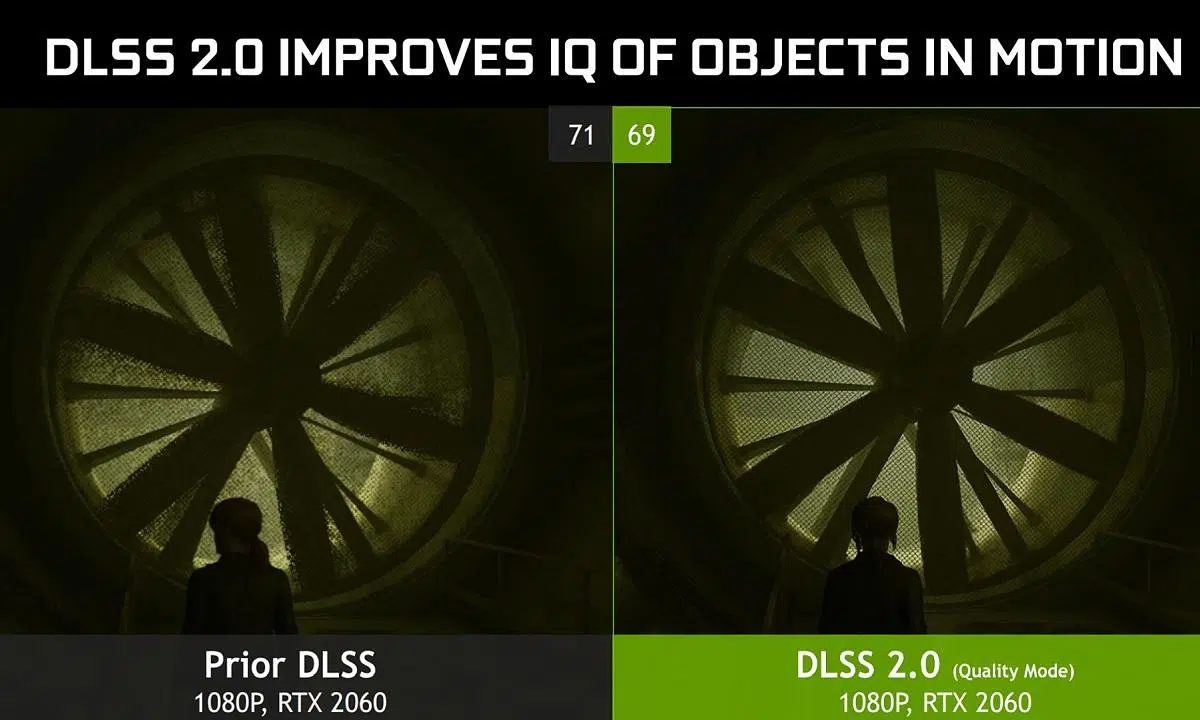
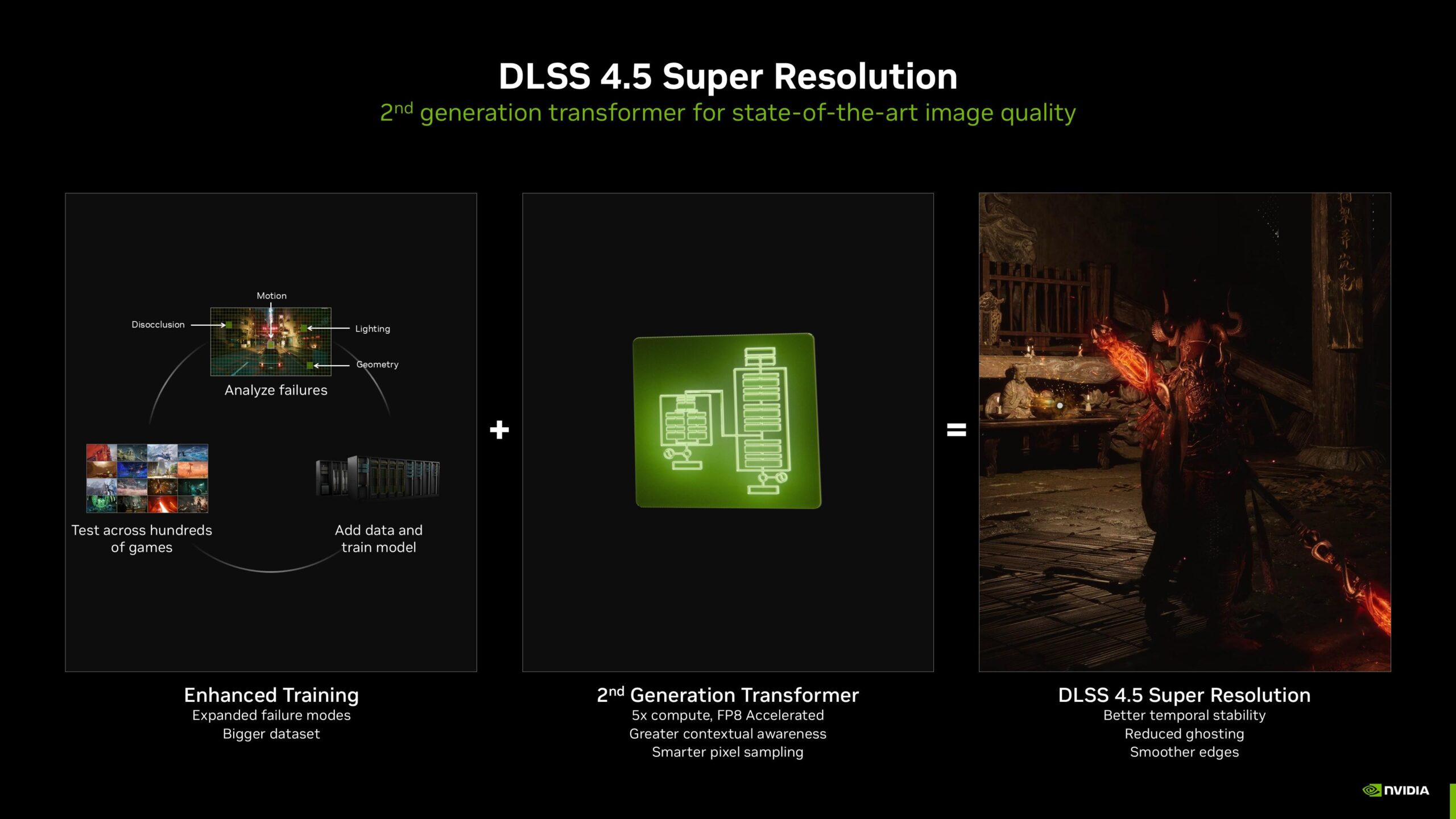
Over time, NVIDIA refined the architecture and training process to develop more general-purpose and versatile models. Versions like DLSS 2, 3, 4, and 4.5 arrived , incorporating new capabilities: improved temporal antialiasing, sharper motion reconstruction, and, very importantly, AI-powered frame generation to increase FPS without the GPU having to render each frame.
All this evolution has gone hand in hand with hardware improvements: each new generation of RTX has brought more powerful and efficient Tensor Cores , as well as new instructions and numerical formats like FP8, which allow for the execution of larger and more complex models without significantly impacting performance. DLSS 5 is, to a large extent, the result of combining this software maturity with the newfound strength of the Blackwell architecture.
Meanwhile, discussions have been circulating within the technical community about exactly how these models are trained. There has been talk of autoencoder-type architectures, where the network learns to compress each image into a dense intermediate representation and then reconstruct it in greater detail. For a game to be compatible, developers collaborate with NVIDIA by sending image data and auxiliary buffers (depth, motion, masks, etc.) that help enrich the training, although the most recent versions of DLSS aim to generalize better and rely less on title-specific training.
In this context, DLSS 5 expands the scope of AI's role in the rendering pipeline . It is no longer limited to "filling" resolution or interpolating frames, but now fully engages in the final definition of materials and lighting, reshaping, to some extent, how modern real-time rendering is understood.
Everything points to DLSS 5 marking a turning point in how PC games manage the balance between visual fidelity, performance, and workload for artists. Whether that balance tips towards more spectacular experiences without sacrificing personality, or conversely towards increasingly uniform, AI-generated graphics, will depend as much on how NVIDIA uses it as on the decisions studios make and how demanding the community is in accepting or rejecting this new visual standard.
