- Analysis of the dual active-active controller architecture to ensure uninterrupted service continuity.
- Implementation of all-NVMe technology to maximize IOPS and reduce latency in mission-critical environments.
- Data optimization strategies using advanced deduplication and next-generation Btrfs file systems.

When we talk about modern technological infrastructures, speed is no longer the only priority; now what really matters is that the system doesn't go down for even a second . In this scenario, NVMe storage with active-active architecture has become the crown jewel for those companies that cannot afford for their services to stop due to a technical failure.
Unlike traditional systems, where one controller sleeps while the other works, here we have a system where both processors are operational simultaneously. This is not just a technical improvement, but a paradigm shift that allows for the management of massive volumes of data with astonishing agility, ideal for those who manage transactional databases or heavy virtualization environments.

Active-Active Architecture: Beyond Simple Redundancy

In the world of enterprise storage, the active-active concept means that both controllers handle input and output requests simultaneously. If one fails, the other instantly absorbs the traffic without the user noticing a thing. To ensure reliability, robust layers of protection are implemented, such as triple parity RAID (RAID-TP), which essentially acts as a safeguard against the loss of multiple disks in high-density systems.
A key point is the use of a non-transparent bridge (NTB). This piece of hardware allows memory writes to be synchronized at full speed between controllers. Without it, if one controller suddenly fails, you could have inconsistent or corrupted data, which would be a real disaster in a financial services or healthcare company.
Furthermore, to make administration a breeze, out-of-band (OOB) management ports are included. Essentially, this is an independent communication channel that allows technicians to remotely access and manage the equipment even if the main data network is degraded or down, thus avoiding unnecessary trips to the data center.
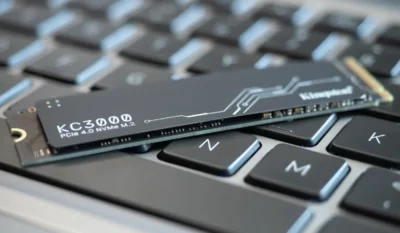
The leap to All-NVMe and extreme performance
The NVMe protocol has broken down all barriers, eliminating the bottlenecks caused by older mechanical hard drives or even SATA SSDs. By basing the entire system on high-speed, permanent memory , it achieves astounding figures, reaching up to 2 million IOPS and sequential performance approaching 30 GB/s.
This power is especially useful in local primary storage. Whether you need a SAN for blocks or a NAS for files, unifying both on a single platform simplifies operations, although it requires the IT administrator to carefully size resources to ensure that different access patterns don't conflict with each other.
To prevent maintenance from becoming a headache, tools like Continuous Availability Manager allow firmware and software updates to be performed without downtime . This is music to any CIO's ears, as maintenance windows cease to be a logistical nightmare.
Space efficiency and cost reduction

Having a lot of processing power is useless if storage fills up in the blink of an eye. That's why advanced deduplication is essential. By using the latest generation Btrfs file systems, you can achieve a 5:1 data reduction ratio . This means you can convert raw capacity into a much larger effective capacity, reaching up to 8,25 PB in some cases.
There are two ways to address this problem: inline deduplication, which cleans the data before writing it, and post-processing, which does it afterward. This combination helps lower the total cost of ownership (TCO) by optimizing rack space and the power consumption of the flash modules.
Additionally, automatic tiering is the smart solution for data that is no longer used as frequently. The system moves less-used data to lower-cost tiers , leaving the more expensive and faster NVMe storage exclusively for applications that are working at full capacity in real time.

Data protection and integrated security
In a world where ransomware attacks are commonplace, it's not enough for a system to be fast; it must be fortified. Implementing self-encrypting drives (SEDs) and full volume encryption ensures that data at rest is protected against unauthorized access.
On the other hand, WORM (Write-Once Read-Many) technology and immutable snapshots are the last line of defense. These features prevent data from being maliciously deleted or modified, allowing companies to recover their information quickly and reduce the RPO (Return on Perception) to minimal levels.
Cloud integration and virtualization
We can't forget the cloud environment, where Azure has integrated NVMe support to enhance its virtual machines. The transition from SCSI to NVMe in next-generation VMs allows web servers and analytics applications to process information with extremely low latency.
Thanks to innovations like Azure Boost, virtualization processes are offloaded from the hypervisor to dedicated hardware. This makes the performance of managed disks much smoother, provided that compatible operating system images and Generation 2 virtual machines are used.
For those using older or home systems, there are command-line (SSH) tricks to try to configure NVMe SSDs as storage volumes instead of simple caches, although this carries risks and requires advanced knowledge of partitioning and RAID management using mdadm in Linux environments.
The convergence of active-active architecture, all-flash storage, and immutable security layers defines the new era of data infrastructure, allowing organizations to scale their operations without fear of hardware failures and optimizing every euro invested in effective capacity and sustained performance.
